


In residential energy modeling under BC Building Code Subsection 9.36.6 (BC Energy Step Code), project teams targeting Step 4 or Step 5 (Net Zero Ready) frequently reach an impasse: envelope airtightness (≤ 1.5 ACH50) and Thermal Energy Demand Intensity (TEDI) pass comfortably, yet the overall model exceeds the mandatory ceiling for Mechanical Energy Use Intensity (MEUI) [1].
An engineering breakdown of modern high-performance envelopes reveals the culprit: Domestic Hot Water (DHW) loads.
As building enclosures become super-insulated and airtight, space heating requirements diminish significantly. Consequently, service water heating expands proportionally, accounting for 30% to over 45% of total mechanical energy consumption in high-performance Part 9 construction [2].
When MEUI limits are breached, teams often consider costly envelope adjustments, such as continuous exterior insulation or custom triple-pane glazing. However, because envelope modifications affect only space heating (TEDI), they deliver zero impact on water heating energy. The direct, cost-effective mechanical solution to this compliance gap is ThermoDrain® Drain-Water Heat Recovery (DWHR).
1. The Modeling Physics: Quantifying MEUI Reductions in HOT2000
Under BCBC Subsection 9.36.6, MEUI accounts for space heating, cooling, ventilation, and domestic water heating normalized over conditioned floor area [1]:
TEDI governs only space heating thermal demand. Altering wall insulation or window specs produces zero reduction in DHW energy use. To lower MEUI after TEDI is secured, domestic water heating energy must be reduced directly.
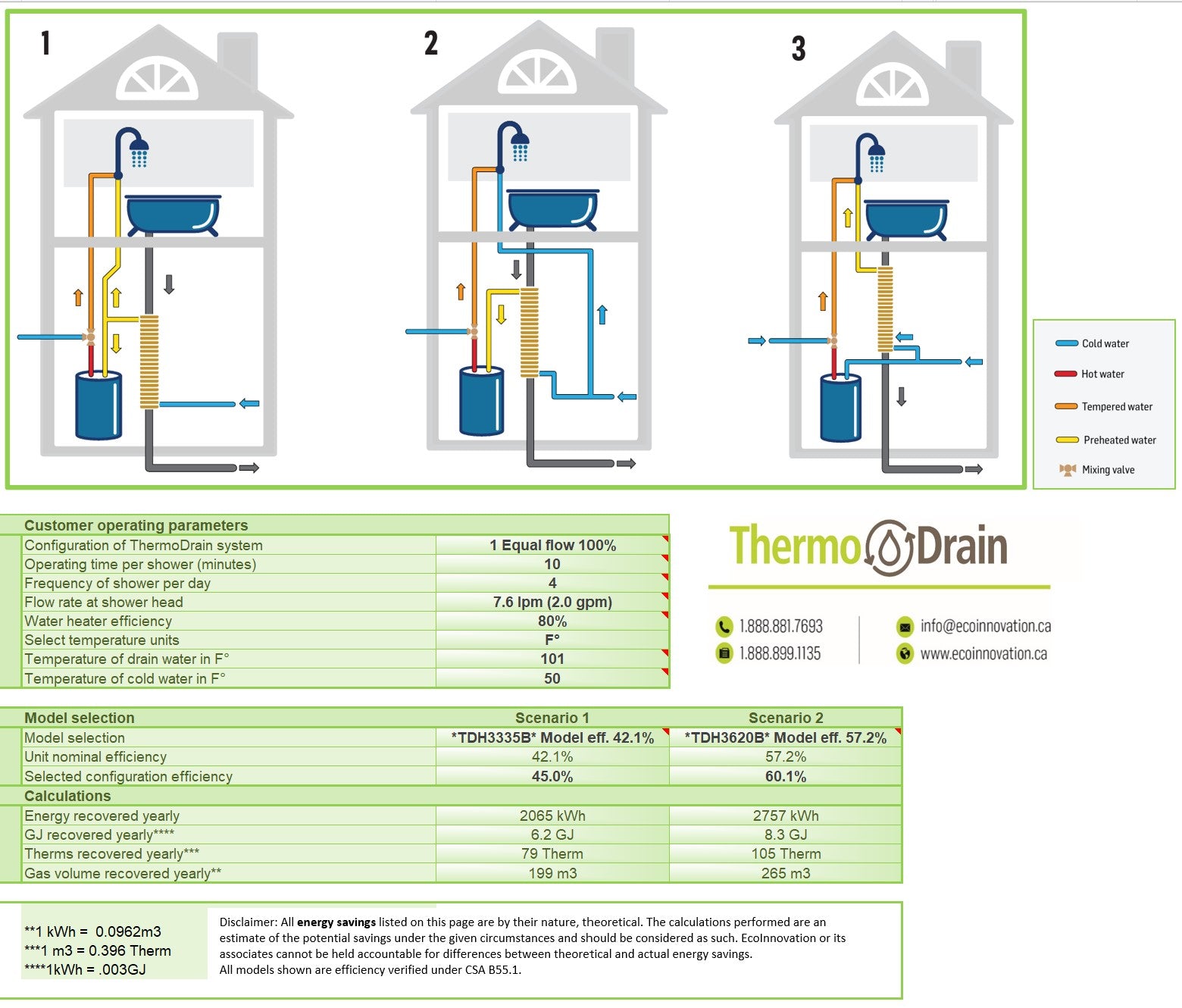
When enabling DWHR in HOT2000 using third-party tested ratings verified under CSA B55.1 (such as the ThermoDrain TDX3350 at 42.10% efficiency or the TDX3615 at 55.04% efficiency), the modeling engine applies falling-film counterflow heat transfer against modeled shower draws [3, 4].
For a representative 200 m² to 240 m² (2,150–2,600 sq. ft.) two-storey detached home in Climate Zone 4 or 5 (Lower Mainland, Vancouver Island, or Okanagan), incorporating a ThermoDrain unit achieves an immediate reduction of 2.0 to 4.5 kWh/(m²·a) in modeled MEUI [2, 5].
| HOT2000 Modeling Iteration (220 m² Home - CZ5) | Modeled TEDI | Modeled MEUI | Step Code Status |
|---|---|---|---|
| Baseline: Air-Source HP + Standard Electric Tank | 26.2 kWh/(m²·a) | 48.1 kWh/(m²·a) | Fails Step 4 (MEUI > 45.0) |
| Iteration 1: Added ThermoDrain TDX3350 (42.10% CSA B55.1) | 26.2 kWh/(m²·a) | 43.9 kWh/(m²·a) | Step 4 Compliant (MEUI ≤ 45.0) |
| Iteration 2: Added ThermoDrain TDX3615 (55.04%) + Hybrid HPWH | 24.8 kWh/(m²·a) | 38.2 kWh/(m²·a) | Step 5 / Net Zero Ready |
2. Capital Cost Comparison: Envelope Adjustments vs. Mechanical DWHR
When modeling indicates a design meets TEDI but fails MEUI, attempting to force compliance through added exterior continuous insulation (R-10 to R-12 ci) introduces practical construction complexities:
- Engineered strapping schedules and extended structural screw fasteners.
- Adjusted rain-screen assemblies, deeper jamb extensions, and wide sill flashings.
- Modified exterior site setbacks or reduced saleable interior floor space.
- Incremental construction costs ranging from $9,000 to $16,000+ per lot.
Targeting the DHW load directly with ThermoDrain DWHR provides a streamlined path to compliance:
- Hardware Investment: ~$550 to $750 CAD wholesale cost (stocked across BC at Andrew Sheret Limited, Wolseley Canada, EMCO Corporation, and Noble).
- Standard Rough-In: Plumbed directly into the 3" DWV drainage stack using standard fittings and basic bracket supports.
- Passive Operation: Operates entirely without electrical connections, pumps, storage tanks, sensors, or scheduled mechanical maintenance.
- Preserved Wall Assemblies: Standard 2×6 R-22/R-24 exterior framing assemblies are retained without requiring expanded foundation ledges or custom window bucks.
3. Winter Morning Coincident Peaks: HPWHs & Element Snapback
Under the Zero Carbon Step Code (ZCSC), municipal jurisdictions across BC (including Vancouver, Victoria, Saanich, and the City of North Vancouver) are restricting operational greenhouse gas emissions, driving adoption of Heat Pump Water Heaters (HPWHs) [6].
In cold-climate winter conditions, hybrid HPWHs face an engineering constraint: instantaneous thermal recovery deficit.
During winter mornings in BC, incoming municipal groundwater drops to 4°C to 8°C (40°F to 46°F). A standard 7.6 L/min (2.0 gpm) shower operating at 40°C (104°F) requires roughly 17.3 kW of instantaneous thermal power [7]:
Because standard residential HPWH compressors generate only 1.2 to 1.6 kWth of heat output, sequential morning showers rapidly exhaust stored water volume [8]. When the lower sensor trips, the unit engages its 4,500W electric resistance backup elements, creating substantial coincident electrical demand during utility morning peak periods (6:00 AM–8:30 AM) [7].
The Passive Countermeasure: ThermoDrain preheats incoming cold potable water to 20°C to 25°C (68°F to 77°F) before it enters the water heater [3]. This reduces instantaneous fixture demand by 30% to 50%, preserves tank thermal stratification, and allows the HPWH to satisfy draws in high-efficiency compressor mode without triggering backup elements.
4. Jurisdictional Plumbing Code Compliance in British Columbia
Plumbing designs must reflect municipal regulatory variations within the province:
A. City of Vancouver (VBBL Book II & Part 10)
- Mandatory Multi-Family DWHR: Under VBBL Sentence 10.2.2.11.(3), DWHR is mandatory on the primary shower of every dwelling unit in Part 10 multi-family buildings (MURBs), requiring ≥ 42% tested efficiency (CSA B55.1) and vented double-wall separation (CSA B55.2) [9].
- Service Water Heater Feed Rule: Under VBBL Book II Article 2.6.1.12.(2), DWHR discharge must route exclusively to the cold inlet of the service water heater. Direct routing to fixture mixing valves ("equal flow") is prohibited under Vancouver plumbing enforcement [9].
B. Provincial British Columbia Building Code (BCBC 2024)
Outside Vancouver, both "Preheat to Water Heater Only" and "Equal Flow" (preheating both the water heater and the shower cold port) configurations are permissible under provincial regulations, provided the unit meets CSA B55.2 atmospheric double-wall vent requirements [4].
5. HOT2000 Energy Modeling Workflow
To ensure project energy compliance documentation aligns with Service Organization (SO) Quality Assurance audits, apply the following setup in HOT2000:
- Navigate to the Domestic Water Heating (DHW) component interface in HOT2000.
- Enable the Drain-Water Heat Recovery (DWHR) checkbox.
- Configuration: Select "Preheat to Water Heater Only" (required in Vancouver; recommended across BC for installation simplicity) or "Equal Flow" if documented on mechanical plans.
- Fixtures Serviced: Enter the percentage of dwelling showers connected to the recovery stack (specify 100% when all upper-level showers route through the unit).
-
Tested Efficiency Values: Input verified CSA B55.1 performance values from the NRCan Searchable Product List [3]:
- TDX3240B (24" core): 33.59%
- TDX3350 (35" core - Step 4 Standard): 42.10%
- TDX3615 (61.5" core - Step 5 Net-Zero High Performance): 55.04%
- TD442 (4" × 42" Commercial/MURB Riser): 46.20%
- TD460 (4" × 60" Commercial/MURB Riser): 55.30%
- Confirm manufacturer naming matches the official directory entry: EcoInnovation Technologies Inc.
6. Technical & Statutory References
- British Columbia Ministry of Housing. (2024). British Columbia Building Code (BCBC 2024), Subsection 9.36.6: Energy Step Code Compliance Metrics and MEUI Definitions. Victoria, BC.
- Natural Resources Canada (NRCan). (2020). Housing Energy End-Use Breakdown and HOT2000 Technical Modeling Guidelines for Part 9 Buildings. Office of Energy Efficiency, Ottawa, ON.
- Natural Resources Canada (NRCan). (2024). Searchable Product List: Drain-Water Heat Recovery (CSA B55.1 Performance Registry). Government of Canada.
- Canadian Standards Association (CSA Group). CSA B55.1 & CSA B55.2 (Efficiency Testing and Vented Double-Wall Safety Standards).
- Burch, J., & Salasovich, J. (2014). Modeling and Field Testing of Drain-Water Heat Recovery Technologies in Residential Construction. NREL Technical Report NREL/TP-5500-60904.
- CleanBC. (2023). Zero Carbon Step Code Implementation Guide: Operational Carbon Targets and Municipal Frameworks. Province of British Columbia.
- Electric Power Research Institute (EPRI). (2020). Residential Electric Load Profiles and Peak Coincidence in Heat Pump Conversions. EPRI Technical Assessment 3002018942.
- Northwest Energy Efficiency Alliance (NEEA). (2022). Advanced Water Heating Specification (AWHS) Version 8.0. Portland, OR.
- City of Vancouver. (2019/2024). Vancouver Building By-law (VBBL) No. 12511: Book II (Plumbing Systems Article 2.6.1.12) and Part 10 (Sentence 10.2.2.11.(3)).
Need Project Sizing Curves or AHJ Submittal Documentation?
Access certified CSA B55.1 performance data, pressure drop curves, verified NRCan registry listings, and MasterFormat 22 31 16 mechanical specifications through EcoInnovation’s engineering desk.







No comment yet, add your voice below!