


Massachusetts Stretch Code & HERS Index: DWHR Engineering Analysis & Calculation Package
A steady-state mass and energy balance evaluating the integration of CSA B55.1 tested Drain Water Heat Recovery (DWHR) units under the Massachusetts Residential Stretch Energy Code (225 CMR 22.00) and Specialized Municipal Opt-In Code (225 CMR 23.00). This application note defines explicit boundary conditions, reconciled enthalpy balances, multi-variable sensitivity modeling across Climate Zone 5A, Ekotrope HERS Index compliance impacts, Mass Save® incentive stacking, and a CSI MasterFormat guide specification for mechanical engineers, architects, and energy raters.
Summary of Engineering Findings (Massachusetts 225 CMR 22.00 & 23.00)
- Clearing Mandatory HERS 42 / 45 Ceilings: Under 225 CMR 22.00 and 23.00, new residential construction must achieve strict HERS Index caps (≤ 45 for all-electric; ≤ 42 for mixed-fuel with mandatory solar PV). Modeling an Equal Flow ThermoDrain unit in Ekotrope or REM/Rate yields an indicative 1.5 to 3.5 point whole-house HERS Index reduction, securing the final compliance margin without cost-prohibitive envelope redesigns.
-
Reconciled Thermal Load Reduction (38.6% to 50.5%): At baseline winter design conditions (45.0°F cold mains, 105.0°F shower at 2.00 GPM, 100.0°F drain inlet, 120.0°F storage), an Equal Flow ThermoDrain
TDX3350(η = 42.10%) preheats cold supply water to 68.2°F. This reduces 120.0°F tank flow draw from 1.60 GPM to 1.42 GPM (-11.3% volumetric flow) while cutting net thermal power demanded from the water heater from 60,000 BTU/hr down to 36,840 BTU/hr (-38.6% net load). - Buffering All-Electric Heat Pump Water Heaters (HPWH): In Massachusetts (Climate Zone 5A), incoming winter water mains enter at 40.0°F–48.0°F. Recovering 23,160 BTU/hr (TDX3350) slows the stored tank enthalpy depletion rate by 41.5% (net storage discharge drops from 55,800 BTU/hr to 32,640 BTU/hr), delaying upper-thermostat temperature drop and reducing the operational staging of 4,500W electric resistance backup elements.
- Sensible Tank Reheat Energy (-30.9%): Reheating the calculated 33.8 gallons of depleted storage volume from 68.2°F to 120.0°F requires 14,590 BTUs vs. 21,125 BTUs for 45.0°F unheated mains water, representing a 30.9% reduction in recharge energy (and ~31% lower compressor runtime under equivalent ambient conditions).
- Standards Differentiation: CSA B55.1:20 (R2025) is the standardized laboratory test method for measuring efficiency and pressure loss (< 2.5 psi at 2.5 GPM); CSA B55.2:20 governs physical double-wall vented air-gap construction to prevent potable contamination. Whole-building HERS outcomes depend on project-specific simulation models.
1. Statutory Framework: 225 CMR 22.00, 23.00 & Mass Save® Alignment
The Massachusetts Department of Energy Resources (DOER) enforces the Residential Stretch Energy Code (225 CMR 22.00) alongside the Specialized Municipal Opt-In Code (225 CMR 23.00) adopted by dozens of cities and towns across the Commonwealth (including Boston, Cambridge, Somerville, Brookline, Newton, and Worcester):
- 225 CMR 22.00 (Standard Stretch Code): Requires all-electric residential new construction to achieve a maximum HERS Index of ≤ 45 (or ≤ 42 for mixed-fuel buildings).
- 225 CMR 23.00 (Specialized Opt-In Code): Establishes a Net-Zero pathway requiring HERS ≤ 45 for all-electric construction without solar, HERS ≤ 42 for mixed-fuel dwellings with mandatory solar PV arrays, or Phius / Passive House Institute certification.
- Mass Save® Residential New Construction (RNC) Program: Sponsors tiered builder incentives tied directly to modeled HERS score improvements and all-electric equipment adoption. Reducing water-heating energy directly increases performance-based cash incentives.
- Section R403.5.4 Installation Mandate: DWHR units must comply with CSA B55.2 and exhibit potable water-side head loss < 10.0 psi (69 kPa) at maximum design flow.
To evaluate mechanical performance without unverified claims, all thermodynamic calculations in this document are established under the explicit boundary conditions below:
Design Operating Parameters (Equal Flow Reference Case):
- Shower Flow Rate (Qs): 2.00 GPM (7.57 L/min) steady-state. Assumes single shower fixture operating; non-concurrent laundry or lavatory draws.
- Mixed Showerhead Delivery Temperature (Ts): 105.0°F (40.6°C).
- Drain Inlet Temperature (Td): 100.0°F (37.8°C), establishing a 5.0°F sensible temperature drop across the shower receptor, pan conduction, and trap arm.
- Incoming Winter Cold Water Main (Tc,in): 45.0°F (7.2°C), representative of Massachusetts winter municipal water supply (MWRA / Boston Water and Sewer Commission winter range: 42°F–47°F; Western MA / Berkshires winter range: 38°F–42°F).
- Storage Tank Setpoint (Th): 120.0°F (48.9°C) delivered at the tank outlet port.
-
Certified Effectiveness (η): Evaluated at published CSA B55.1:20 laboratory test ratings: 42.10% for ThermoDrain
TDX3350and 55.04% for ThermoDrainTDX3615. Rated test values are applied directly without unverified field adjustments. - Thermodynamic Constant: Density and specific heat of water modeled as constant ($500\text{ BTU}/(\text{hr}\cdot\text{GPM}\cdot^\circ\text{F})$, representing $\rho = 8.34\text{ lb/gal}$ and $C_p = 1.00\text{ BTU}/(\text{lb}\cdot^\circ\text{F})$).
2. Reconciled Steady-State Heat & Mass Balance Equations
Under steady-state continuous flow, the mass and energy balances across the mixing valve, DWHR exchanger, and storage tank are governed by Equations 1 through 5:
(Eq. 2) 120°F Tank Draw Rate: Q_h = Q_s × (T_s − T_pre) / (T_h − T_pre)
(Eq. 3) Total Showerhead Demand: q_shower = 500 × Q_s × (T_s − T_c,in)
(Eq. 4) Heat Recovered by DWHR: q_dwhr = 500 × Q_s × (T_pre − T_c,in)
(Eq. 5) Net Thermal Tank Load: q_tank = 500 × Q_h × (T_h − T_pre) = q_shower − q_dwhr
| Thermodynamic Parameter | Baseline (No DWHR) Tc = 45.0°F |
With TDX3350 η = 42.10% (CSA B55.1) |
With TDX3615 η = 55.04% (CSA B55.1) |
|---|---|---|---|
| Preheated Potable Temp (Tpre) | 45.0°F | 68.2°F (+23.2°F lift) | 75.3°F (+30.3°F lift) |
| Tank Hot Water Flow (Qh) | 1.60 GPM | 1.42 GPM (-11.3% vol.) | 1.33 GPM (-16.9% vol.) |
| Cold Mixing Bypass Flow (Qc) | 0.40 GPM (at 45.0°F) | 0.58 GPM (at 68.2°F) | 0.67 GPM (at 75.3°F) |
| Total Showerhead Demand (qshower) | 60,000 BTU/hr (17.58 kW) | 60,000 BTU/hr (17.58 kW) | 60,000 BTU/hr (17.58 kW) |
| Heat Recovered by DWHR (qdwhr) | 0 BTU/hr | 23,160 BTU/hr (6.79 kW) | 30,270 BTU/hr (8.87 kW) |
| Net Thermal Load on Tank (qtank) | 60,000 BTU/hr | 36,840 BTU/hr (-38.6%) | 29,730 BTU/hr (-50.5%) |
| Active Compressor Output (Nominal) | 4,200 BTU/hr (1.23 kW) | 4,200 BTU/hr (1.23 kW) | 4,200 BTU/hr (1.23 kW) |
| Net Stored Enthalpy Depletion Rate (qtank − qcomp) |
55,800 BTU/hr deficit | 32,640 BTU/hr deficit (-41.5%) | 25,530 BTU/hr deficit (-54.2%) |
Distinguishing Volumetric Flow Rate from Thermal Enthalpy
A frequent modeling misconception is equating volumetric tank draw reduction with net thermal energy savings. Under the TDX3350 baseline, 120.0°F hot water drawn from the tank drops by 11.3% (from 1.60 GPM to 1.42 GPM). However, because incoming replacement water entering the bottom dip tube is preheated to 68.2°F instead of 45.0°F, the required temperature lift across the water heater is reduced from 75.0°F to 51.8°F. The compound product of lower flow and reduced temperature lift yields the 38.6% reduction in instantaneous thermal load (BTU/hr).
3. Multi-Variable Sensitivity Analysis: Climate Zone 5A (Massachusetts)
Massachusetts municipal water temperatures vary from coastal Boston (MWRA) to elevated Western Massachusetts (Berkshires / Franklin County). Table 2 evaluates system response across varying cold mains temperatures, drain temperatures, and fixture flow rates using the ThermoDrain TDX3350 (η = 42.10%):
| Simulation Case | Mains (Tc,in) | Drain (Td) | Flow (Qs) | Preheat (Tpre) | Tank Draw (Qh) | Baseline Qh | Net Load Reduction |
|---|---|---|---|---|---|---|---|
| Case 1: Greater Boston Winter (MWRA) | 45.0°F | 100.0°F | 2.00 GPM | 68.2°F | 1.42 GPM | 1.60 GPM | -38.6% (-23,160 BTU/h) |
| Case 2: Berkshires Deep Winter (Pittsfield) | 39.0°F | 98.0°F | 2.00 GPM | 63.8°F | 1.47 GPM | 1.63 GPM | -38.3% (-24,840 BTU/h) |
| Case 3: Coastal Shoulder Season (Cape Cod) | 54.0°F | 100.0°F | 2.00 GPM | 73.4°F | 1.36 GPM | 1.55 GPM | -38.0% (-19,370 BTU/h) |
| Case 4: WaterSense Low-Flow Showerhead | 45.0°F | 98.0°F | 1.50 GPM | 67.3°F | 1.07 GPM | 1.20 GPM | -37.3% (-16,730 BTU/h) |
| Case 5: Conservative Trap Arm Heat Loss | 45.0°F | 95.0°F | 2.00 GPM | 66.1°F | 1.44 GPM | 1.60 GPM | -35.1% (-21,050 BTU/h) |
4. Ekotrope Modeling Protocol & HERS Index Impact
In Massachusetts, HERS compliance is established primarily through Ekotrope RATER or REM/Rate in accordance with ANSI/RESNET/ICC Standard 301. Energy raters modeling DWHR to satisfy 225 CMR 22.00 / 23.00 must adhere to the following input protocol:
Ekotrope Mechanical Input Parameters for ThermoDrain:
- Component Type: Select Drain Water Heat Recovery (DWHR) under the Service Water Heating tab.
- Exchanger Efficiency (%): Enter published CSA B55.1 tested efficiency: 42.10% for TDX3350; 55.04% for TDX3615.
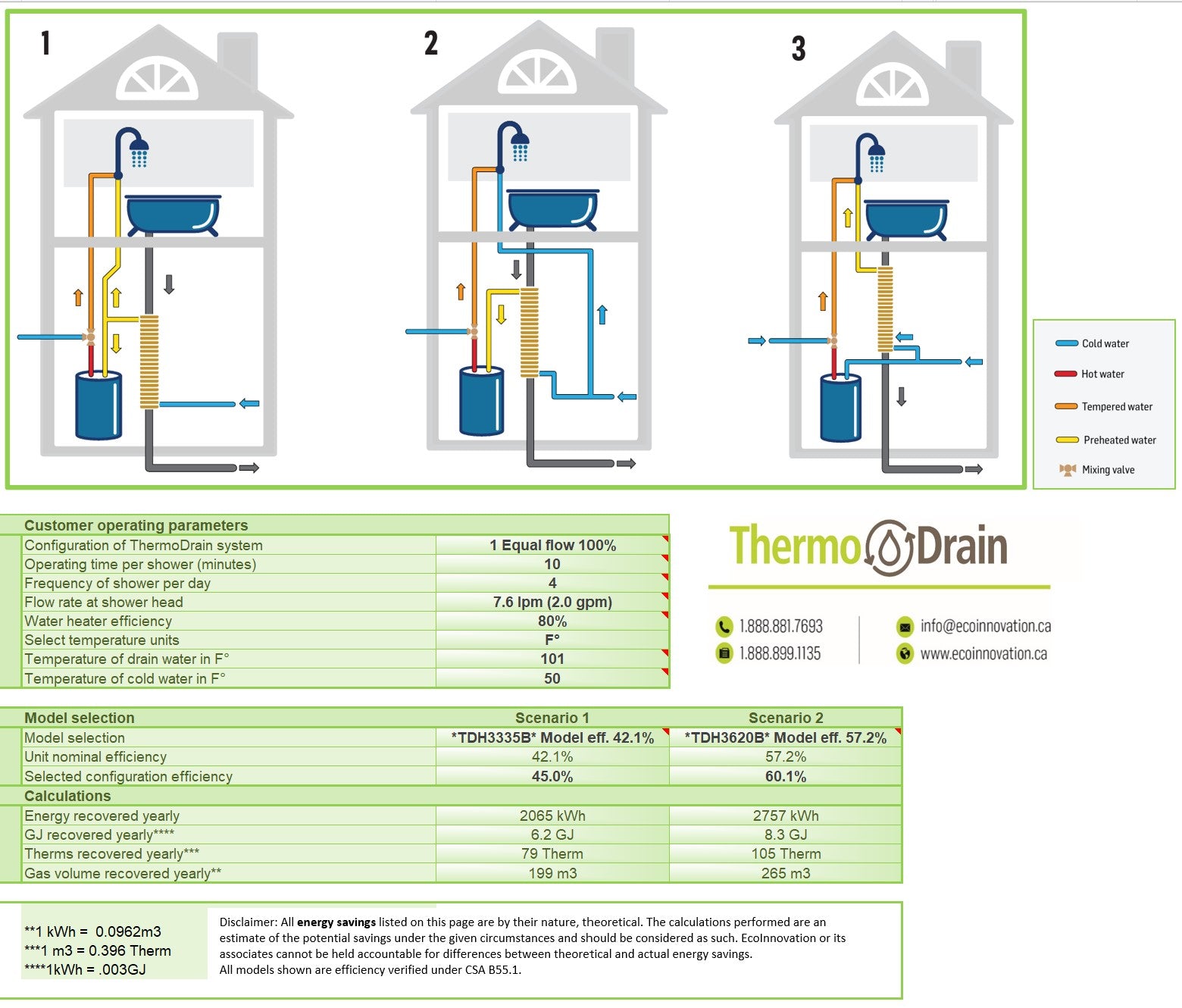
- Piping Configuration: Select Equal Flow (both water heater and shower cold port preheated) or Unequal Flow (water heater inlet only).
- Facilities Served: Select Showers only (or specify multi-fixture stack configuration).
- Potable Water-Side Head Loss: Enter 2.5 psi (certified < 2.5 psi at 2.5 GPM per CSA B55.1 test report).
Modeled Point Impact: In a typical 2,400 sq. ft., 3-bedroom Massachusetts single-family home with an electric Heat Pump Water Heater, modeling an Equal Flow ThermoDrain unit typically yields a 1.5 to 3.5 point reduction in the HERS Index (and 3.0 to 5.0+ points when paired with an electric resistance or legacy fossil fuel baseline). When a builder is sitting at HERS 46 under the Specialized Opt-In Code, this 2-point mechanical delta secures the HERS ≤ 45 pass without modifying the building envelope.
5. Comparative Economics: Mechanical DWHR vs. Envelope Upgrades
When a project team must drop 2 to 3 HERS points to hit Massachusetts Stretch or Opt-In Code caps, comparing mechanical DWHR integration against opaque envelope upgrades demonstrates relative capital costs and framing complexity:
| Compliance Strategy | Estimated Cost Delta | Modeled HERS Impact | Framing & Field Constructability |
|---|---|---|---|
| Triple-Pane Glazing Package (U-0.18 to U-0.20) | +$5,000 – $9,000 USD | -1.5 to -2.5 HERS points | Requires structural bucking, heavier hinges, and modified rough openings. |
| Exterior Continuous Foam (R-10 ci Walls) | +$6,500 – $10,500 USD | -2.0 to -3.5 HERS points | Demands window jamb extensions, rainscreen fasteners, and modified flashing. |
| Sub-Slab R-10 Rigid Foam Insulation | +$3,200 – $5,500 USD | -1.0 to -2.0 HERS points | Requires careful detailing at foundation footings, slab edges, and under-slab plumbing. |
| ThermoDrain® TDX3350 / TDX3615 | ~$325 – $525 USD (Equip.) | -1.5 to -3.5 HERS points | Zero structural changes. Fits in standard 3.5" wall chase. 45-min plumbing rough-in. |
6. ThermoDrain® Model Specifications (CSA B55.1 & CSA B55.2)
| Model Number | Stack & Length | CSA B55.1 Eff. | Primary Massachusetts Code Application |
|---|---|---|---|
| TDX3350 | 3.0" Stack × 35.0" (889 mm) | 42.10% | Standard Builder Baseline: Single-Family Stretch Code HERS 45 Cap |
| TD442 | 4.0" Stack × 42.0" (1067 mm) | 46.20% | Multifamily (Group R-2): Commercial 4" Wet-Vented Stacks & Central Plants |
| TDX3615 | 3.0" Stack × 61.5" (1562 mm) | 55.04% | High-Yield / Net-Zero: Specialized Opt-In HERS 42 Cap & Phius Passive House |
| TDX3240B | 3.0" Stack × 24.0" (610 mm) | 33.59% | Restricted Vertical Clearance: Fits Basements & Crawlspaces < 32" Clear Height |
7. Constructability & Massachusetts Wholesale Distribution
Plumbing subcontractors across Greater Boston, Central Massachusetts, the Pioneer Valley, and Cape Cod can source ThermoDrain units through regional commercial wholesale supply networks:
- Solvent-Weld Drain Hubs: Direct factory ABS or PVC hubs cement directly into standard DWV drain lines using solvent cement—eliminating mechanical rubber shielded couplings and ensuring rigid joint compliance under the Massachusetts State Plumbing Code (248 CMR).
- Factory 3/4" PEX Fittings: Potable connections comply with ASTM F1807 (metal crimp) and ASTM F1960 (cold expansion), requiring no open torches or soldering near wood framing studs.
- Vertical Plumb Tolerance: Exchangers must be installed vertically within 5 degrees of plumb on the primary shower stack to maintain uniform falling-film annular fluid mechanics.
8. CSI MasterFormat 3-Part Guide Specification (Section 22 31 16)
Mechanical engineers and architects submitting permit drawings in Massachusetts Stretch and Opt-In Code municipalities can insert this specification block directly into plumbing schedules:
PART 1 — GENERAL
1.1 SECTION INCLUDES: Vented double-wall falling-film drain water heat recovery units for Massachusetts 225 CMR 22.00 / 23.00 Stretch and Specialized Opt-In Code HERS compliance.
1.2 QUALITY ASSURANCE: Unit shall be tested and listed in accordance with CSA B55.1:20 (R2025) and certified to CSA B55.2:20. Potable water-side head loss shall not exceed 10.0 psi at design flow per IECC R403.5.4 (tested at < 2.5 psi at 2.5 GPM). Certified efficiency shall be rated in accordance with CSA B55.1.
PART 2 — PRODUCTS
2.1 ACCEPTABLE MANUFACTURER: EcoInnovation Technologies Inc. (ThermoDrain Series TDX/TD).
2.2 PRODUCT SPECIFICATION: Model [TDX3350 (3" stack, 42.10% eff.) / TDX3615 (3" stack, 55.04% eff.) / TD442 (4" stack, 46.20% eff.)]. Exchanger shall feature seamless Type DWV copper drain core with exterior mechanically bonded double-wall copper potable wrap and vented atmospheric path between fluid streams.
2.3 CONNECTIONS: Drain connections shall be factory ABS or PVC direct solvent-weld hubs. Potable water connections shall be factory 3/4" PEX (ASTM F1807 / ASTM F1960).
PART 3 — EXECUTION
3.1 INSTALLATION: Install unit vertically on primary shower drain stack, not exceeding 5 degrees from plumb. Maintain manufacturer specification label visible for pre-drywall HERS rating inspection.
3.2 PIPING CONFIGURATION: Plumb in Equal Flow arrangement: route potable preheated outlet to feed both the cold inlet of the primary domestic water heater and the cold inlet port of the primary shower thermostatic mixing valve. Provide full-port isolation valves and drain port on potable inlet/outlet.
3.3 INSULATION: Insulate all exposed preheated potable piping with minimum R-3 closed-cell elastomeric pipe insulation complying with IECC Section R403.5.3.
Permitting a Residential Project in Massachusetts?
EcoInnovation supports Massachusetts architects, mechanical engineers, and HERS Raters with CSA B55.1 submittal certificates, Ekotrope modeling documentation, and regional wholesale pricing.









No comment yet, add your voice below!