


Electrification’s Hidden Morning Peak: How Drain-Water Heat Recovery Mitigates Distribution Grid Strain from Residential Heat Pump Water Heaters
This paper demonstrates that passive, falling-film Drain-Water Heat Recovery (DWHR) certified under CSA B55.1 reduces instantaneous domestic hot water load by 30% to 50%. This passive lift keeps water temperatures above resistance engagement setpoints, permanently shifting the coincident peak downward. Furthermore, at an unsubsidized Levelized Cost of Conserved Energy (LCCE) of $0.024–$0.038 per kWh over a 50-year service life, DWHR represents the most capital-efficient demand-side asset available to grid planners—requiring zero lithium, zero inverters, and zero parasitic operating load.
1. The Thermodynamic Mismatch in Water Heating Electrification
Residential energy policy has historically treated water heating as an equipment generation efficiency challenge rather than an instantaneous thermal dissipation challenge. A typical residential shower operates at a flow rate of 1.8 to 2.5 gallons per minute (gpm) [6.8 to 9.5 L/min] at a delivery temperature of 104°F (40°C). In northern and continental climates during winter design conditions, incoming potable groundwater temperatures drop to 40°F to 50°F (4.4°C to 10.0°C) [1].
The instantaneous thermal power (Q) required to heat water for a single 2.0 gpm shower under winter conditions is calculated as:
Q = (2.0 gpm × 8.34 lb/gal × 60 min/hr) × 1.0 Btu/(lb·°F) × (104°F - 45°F)
Q = 1,000.8 lb/hr × 59°F = 59,047 Btu/hr = 17.30 kWthermal
A standard 50- to 80-gallon residential hybrid heat pump water heater (e.g., NEEA Tier 3/4 rated) utilizes a sealed compressor drawing roughly 400 to 550 W of electrical input, generating an output of 4,200 to 5,500 Btu/hr (~1.2 to 1.6 kWthermal) under nominal ambient conditions [2].
Consequently, an operating shower extracts thermal energy from the storage vessel at over ten times the rate at which the heat pump compressor can replenish it. The storage volume functions as an operational buffer. However, in typical single-family homes with sequential morning showers, the tank experiences rapid thermal de-stratification. Once the lower tank sensor drops below the control threshold (typically ≤ 105°F / 40.5°C), internal logic commands the 4,500 W upper and lower electric resistance elements to engage.
2. Distribution Grid Implications: The Coincident Winter Morning Peak
From an electric utility perspective, space heating peak demand is distributed across varying envelope heat loss coefficients and thermostat schedules. In contrast, domestic water heating demand is highly synchronous. Residential draw profiles documented by the National Renewable Energy Laboratory (NREL) and the Electric Power Research Institute (EPRI) demonstrate severe load concentration between 6:00 AM and 8:30 AM [3].
When mass deployment of HPWHs occurs without passive efficiency measures, distribution substations and feed transformers face a severe coincident peak:
- Compressor COP Degradation: Unconditioned basements and garages frequently hover at 40°F to 50°F (4.4°C to 10°C) during winter mornings. Under these ambient temperatures, HPWH coefficient of performance (COP) falls from rated test values of >3.5 down to 1.8–2.2, extending the thermal recovery window [4].
- Element Snapback: Because recovery cannot occur before the next bather enters the shower, auxiliary resistance heating remains locked on for 45 to 90 consecutive minutes per household.
- Transformer Overloading: A residential feeder designed for an average diversified winter morning demand of 1.5 to 2.5 kW per home experiences localized load surges exceeding 5.0 to 6.5 kW per home when resistance backup elements trigger simultaneously.
3. Quantitative Thermodynamic Impact of DWHR Integration
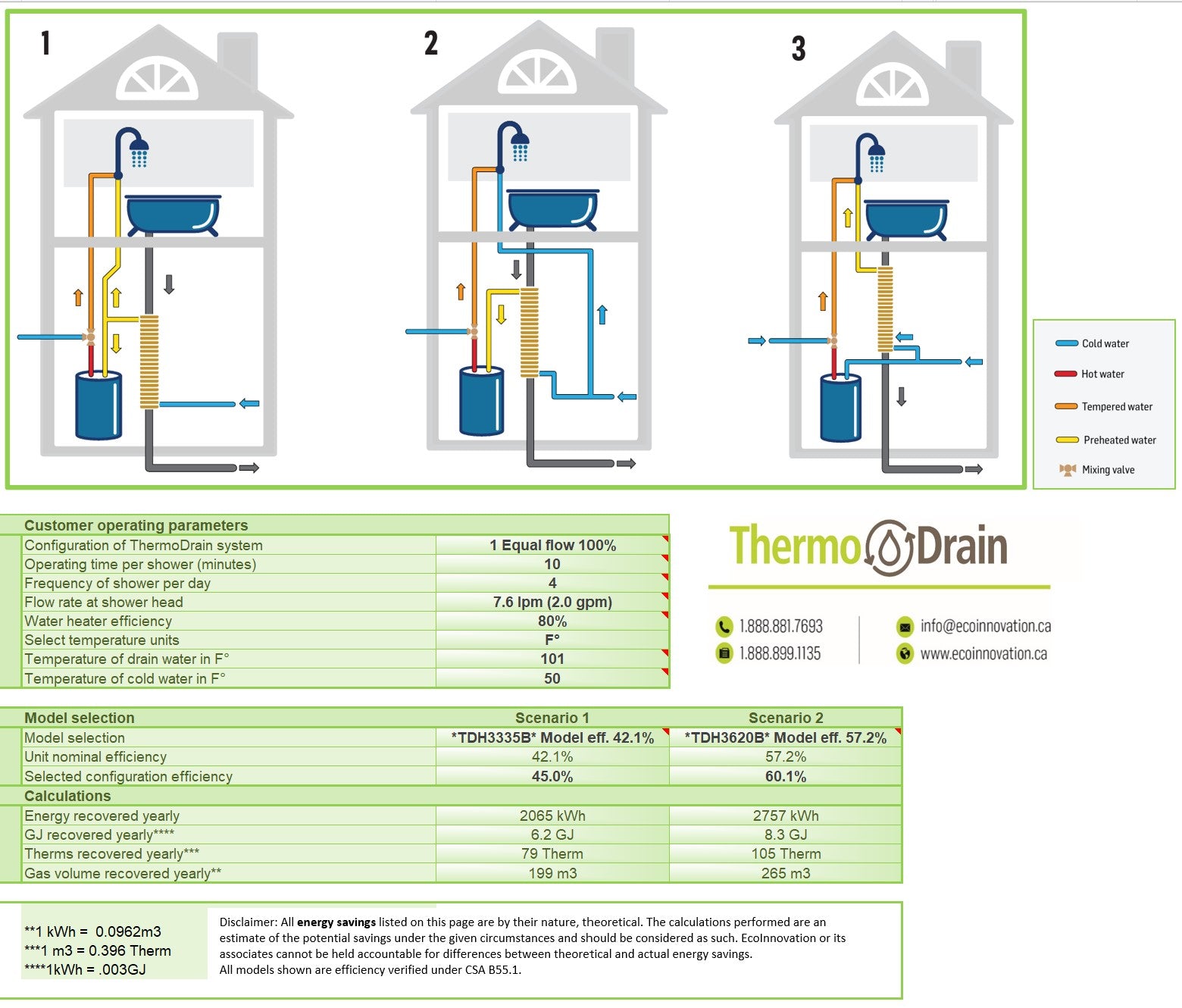
Drain-Water Heat Recovery systems operating on vertical drainage stacks employ gravity-driven annular falling-film physics. As wastewater descends the inner perimeter of a Type DWV copper pipe, surface tension causes the liquid to spread into a uniform film approximately 0.01 to 0.02 inches thick. Fresh, pressurized potable water ascends through a multi-tube counterflow copper coil wound tightly around the exterior.
Heat transfer effectiveness (ε) is independently tested and verified under CSA B55.1 across standardized flow rates (typically indexed at 9.5 L/min or 2.5 gpm) and verified for cross-contamination safety under CSA B55.2.
First-Principles Thermal Performance Model
Shower drainage enters the vertical stack at approximately 98°F (36.7°C), accounting for sensible heat loss to the fixture basin, air path, and drain trap [5]. For incoming potable municipal water at 45°F (7.2°C), preheated water exiting the DWHR unit is defined by:
| System Configuration | CSA B55.1 Efficiency (ε) | Preheated Delivery Temp | Fixture Thermal Load Reduction | Equivalent kW Avoided |
|---|---|---|---|---|
| Baseline (No DWHR) | 0.00% | 45.0°F (7.2°C) | 0.0% | 0.0 kW |
| ThermoDrain TDX3240B (24") | 33.59% | 62.8°F (17.1°C) | 30.1% | 5.21 kWth |
| ThermoDrain TDX3350 (35") | 42.10% | 67.3°F (19.6°C) | 37.8% | 6.54 kWth |
| ThermoDrain TDX3615 (61.5") | 55.04% | 74.2°F (23.4°C) | 49.4% | 8.55 kWth |
Impact on Heat Pump Water Heater Resistance Element Triggering
When preheated potable water at 67.3°F to 74.2°F is introduced to the domestic system:
- In Equal-Flow Configurations (Shower Cold + Tank Preheated): The thermostatic or pressure-balancing shower mixing valve throttles down the required hot-water supply from ~78% of total volume down to ~65% (for TDX3350) or ~55% (for TDX3615). Total volumetric extraction from the storage tank is reduced by 30% to 42%.
- Stratification Preservation: The incoming replacement water entering through the tank dip tube is 22°F to 29°F warmer than unmitigated groundwater. This significantly slows the degradation of the lower tank thermistor, allowing the 1.5 kW heat pump compressor to service multi-shower events without triggering the 4.5 kW electric resistance element.
4. Economic & Capital Comparison: Levelized Cost of Conserved Energy (LCCE)
Utility Demand-Side Management (DSM) frameworks routinely evaluate battery energy storage systems (BESS), solar PV, and heat pumps. However, passive DWHR delivers superior capital efficiency per kilowatt-hour saved because it possesses no active electronics, requires zero operating energy, and has an empirical service life matching that of building plumbing copper (≥ 50 years).
The Levelized Cost of Conserved Energy (LCCE) is calculated using the Capital Recovery Factor (CRF):
where: CRF = [r × (1 + r)n] / [(1 + r)n - 1]
r = Discount Rate (3.5% real) • n = Asset Service Lifetime (50 years) • O&M = $0.00
| Asset Class | Capital Cost / Unit | Asset Life (n) | Parasitic O&M | LCCE ($ / kWh saved) |
|---|---|---|---|---|
| ThermoDrain DWHR (Residential) | $550–$750 USD | 50 Years | $0.00 / yr | $0.024 – $0.038 |
| Residential Lithium-Ion BESS | $10,000–$14,000 USD | 12 Years | $150 / yr | $0.140 – $0.220 |
| Deep Envelope Retrofit (R-12 ci Wall) | $8,000–$16,000 USD | 30 Years | $0.00 / yr | $0.085 – $0.145 |
| Rooftop Solar PV (Distributed) | $15,000–$22,000 USD | 25 Years | $120 / yr | $0.065 – $0.095 |
Unlike lithium-based battery storage, DWHR embodies zero toxic materials, produces zero operational degradation, and utilizes 100% recyclable Grade A copper with a Global Warming Potential (GWP) of zero throughout its operational life.
5. Policy & Code Gaps: Strategic Recommendations
Despite clear thermodynamic performance and statutory testing standards (CSA B55.1 / CSA B55.2), current code structures often undervalue or omit DWHR. The following policy interventions are recommended:
A. For US State Energy Offices & Public Utility Commissions (NYSERDA, CEC, WSEO)
- Implement "Clean Peak" DWHR DSM Incentives: Utility rebate programs currently subsidize HPWH equipment at $500 to $1,500 per unit, but rarely mandate or incentivize DWHR pairing. Electric utilities should provide prescriptive upstream contractor rebates ($250 to $500) specifically for pairing DWHR with HPWH installations to safeguard distribution transformers from winter element snapback.
- California Title 24 & IECC Prescriptive Mandate: Elevate DWHR from an optional performance trade-off to a prescriptive baseline requirement for new multi-story residential construction with vertical drain stacks, mirroring the low-flow fixture mandates of the 1990s.
B. For Canadian Regulators (NRCan, Canadian Commission on Building Codes)
- Scale the Vancouver VBBL Mandate Nationally: The City of Vancouver established a clear precedent in VBBL Sentence 10.2.2.11.(3) by making DWHR mandatory in multi-family residential construction. The National Building Code of Canada (NBC) Part 9 and Part 3 should adopt this clause nationally for all buildings with vertical drainage configurations.
- NBC Tier 4 & Tier 5 Compliance Relief: To meet 2030 Net-Zero Ready performance targets without worsening housing construction affordability, provincial ministries should formally position DWHR as the primary domestic hot water compliance asset, mitigating the need for expensive exterior continuous insulation assemblies.
6. Technical References & Institutional Literature
- Burch, J., & Salasovich, J. (2014). Modeling and Field Testing of Drain-Water Heat Recovery Technologies in Residential Construction. National Renewable Energy Laboratory (NREL), Technical Report NREL/TP-5500-60904. https://www.nrel.gov/docs/fy14osti/60904.pdf
- Northwest Energy Efficiency Alliance (NEEA). (2022). Advanced Water Heating Specification (AWHS) Version 8.0. Standard performance metrics for cold-climate heat pump water heater compressor and resistance operation. https://neea.org/resources/advanced-water-heating-specification
- Electric Power Research Institute (EPRI). (2020). Residential Electric Load Profiles and Peak Coincidence in Heat Pump Conversions. EPRI Technical Assessment 3002018942.
- Shapiro, C., & Puttagunta, S. (2016). Field Performance of Heat Pump Water Heaters in Unconditioned Space in Cold Climates. US Department of Energy (DOE) Building Technologies Office, Consortium for Advanced Residential Buildings (CARB). https://www.osti.gov/biblio/1338692
- Natural Resources Canada (NRCan) / CANMET Energy. (2018). Thermal Effectiveness Verification and Testing Protocols for Falling-Film Drain Water Heat Recovery Devices under CSA B55.1 Standards. Energy Technology Sector, Ottawa, ON.
- City of Vancouver. (2019/2024). Vancouver Building By-law (VBBL) Book II (Plumbing Systems Article 2.6.1.12) & Part 10 (Building Energy Sentence 10.2.2.11.(3)). City of Vancouver Standards.
- Ontario Ministry of Municipal Affairs and Housing. (2024). Ontario Building Code Compendium (O. Reg. 332/12): Part 7 (Plumbing Article 7.4.9.1.(3) Exemption) and Supplementary Standard SB-12. Queen’s Printer for Ontario.
Request Technical Testimony or Sizing Validation for Policy Dockets
EcoInnovation Technologies’ engineering team provides verified modeling data, pressure drop curves, and technical testimony for utility DSM filings, municipal code hearings, and ASHRAE committee reviews.









No comment yet, add your voice below!