


As residential energy codes tighten nationwide, HERS Raters and Energy Advisors (EAs) face a familiar headache: diminishing returns on the building envelope.
With modern homes routinely hitting 1.5 to 3.0 ACH50 and standard wall assemblies packed with R-20+ cavity insulation, squeezing out those final 1 to 3 HERS Index points to hit ENERGY STAR® v3.2, DOE Zero Energy Ready Home (ZERH), or qualifying for the Section 45L Federal Tax Credit ($2,500 to $5,000 per door) has become cost-prohibitive.
When you suggest triple-pane windows or continuous exterior rigid foam, production builders balk at the thousands of dollars in framing adjustments, jamb extensions, and architectural revisions.
There is a much simpler mechanical lever that models directly in Ekotrope, REM/Rate, and EnergyGauge: Drain Water Heat Recovery (DWHR) with the ThermoDrain® TDX3240B.
The Blind Spot: Domestic Hot Water in High-Performance Homes
In traditional code-minimum homes, space heating and cooling dominated the pie chart. But as air tightness and building enclosures improve, space conditioning loads plummet—leaving domestic water heating (DHW) as the second-largest energy end-use, accounting for 25% to 40% of total energy consumption.
Every gallon of ~100°F shower water pouring down the drain is paid-for energy wasted to the municipal sewer.
The ThermoDrain TDX3240B captures that thermal energy in real-time. Operating on the fluid-dynamic principle of falling film flow, wastewater naturally clings to the inner copper pipe in a thin, continuous sheet. Cold municipal water circulating through the tightly wound outer coils absorbs this thermal energy, entering the water heater and shower mixing valve at 70°F–80°F instead of 45°F–50°F.
The Cost-Per-Point Showdown: TDX3240B vs. Conventional HERS Upgrades
In residential energy modeling, ROI comes down to cost per HERS point dropped. Here is how closing a 1 to 2 HERS point gap compares across common compliance measures in single-family residential modeling:
| Compliance Strategy | HERS Point Drop | Added Cost to Builder | Cost Per HERS Point | Architectural / Framing Impact |
|---|---|---|---|---|
| Triple-Pane Windows (Full Package) | 1.0 – 2.0 pts | $5,500 – $11,000 | $3,500 – $5,500 / pt | Heavy structural framing, bucking adjustments |
| Continuous Exterior Foam (R-5+) | 1.5 – 2.5 pts | $6,000 – $9,500 | $3,000 – $4,000 / pt | Extended jambs, rainscreen changes, siding detailing |
| High-Tier Heat Pump Water Heater | 2.0 – 4.0 pts | $2,500 – $3,500 | $800 – $1,250 / pt | Space conditioning penalty (cools indoor space), noise |
| ThermoDrain TDX3240B (24") | 1.0 – 1.5+ pts | ~$185 USD (MSRP) | ~$150 – $350 / pt (Installed) | Zero architectural or framing changes |
At an equipment cost starting at ~$185 USD, the TDX3240B delivers 33.59% certified CSA B55.1 heat recovery efficiency at roughly $5.50 per 1% of efficiency recovered. It represents the lowest capital outlay per point of any measure in the RESNET energy modeling library.
Why Builders and Plumbing Trades Actually Install It
Energy Raters know that the best modeled spec is useless if trades push back in the field. The TDX Series was completely re-engineered to eliminate trade friction:
- Direct Solvent Weld (Glue-In) Drain Connection: Unlike older DWHR units that relied on mechanical rubber coupling sleeves (Ferncos) and torque wrenches, the TDX features ABS/PVC-compatible hubs that solvent-weld directly into standard 3" drain stacks using standard plumbing glue.
- Factory-Installed PEX Fittings: No torches, no fire-watch near wood framing, and no copper sweat soldering. The potable side comes with factory-integrated 3/4" PEX connections (ASTM F1807 crimp or ASTM F1960 cold expansion).
- 45-Minute Rough-In: Any licensed plumbing crew can cut the stack, glue the unit in place, and crimp two PEX lines in under 45 minutes during standard rough-in.
- Zero Callbacks: Built with a rugged stainless steel outer protective armor protecting a 100% antimicrobial copper core, the unit is 100% passive. No pumps, no circuit boards, no moving parts, and a 40+ year operational lifespan.
What Homeowners Actually Experience (The Tangible Sell)
Thicker attic insulation and advanced house wraps are invisible to homeowners. The ThermoDrain delivers immediate, noticeable comfort benefits that builders can market:
- 3x More Hot Shower Delivery: Because incoming water is preheated before entering the storage tank, the water heater discharges significantly less stored hot water per minute of shower time. A standard 50-gallon tank performs like a 90-gallon system, ending cold-shower anxiety for busy families.
- 30% to 40% Utility Bill Reductions: In cold-weather climates where winter groundwater drops below 45°F, shower water heating expenses drop immediately.
- 100% Safe Drinking Water: Certified under CSA B55.1 / B55.2 and IAPMO IGC 346 / UPC, the unit features a true double-wall vented design. Drain water and potable water are separated by two distinct copper walls and an open air gap, making cross-contamination physically impossible.
How to Model the TDX3240B in Ekotrope & REM/Rate
To ensure your energy simulation captures the maximum HERS point deduction:
- Software Library: Navigate to the Drain Water Heat Recovery (DWHR) component library in Ekotrope or REM/Rate.
- Efficiency Rating: Enter the certified CSA B55.1 rated efficiency: 33.59% (at standard 2.5 GPM / 9.5 LPM flow).
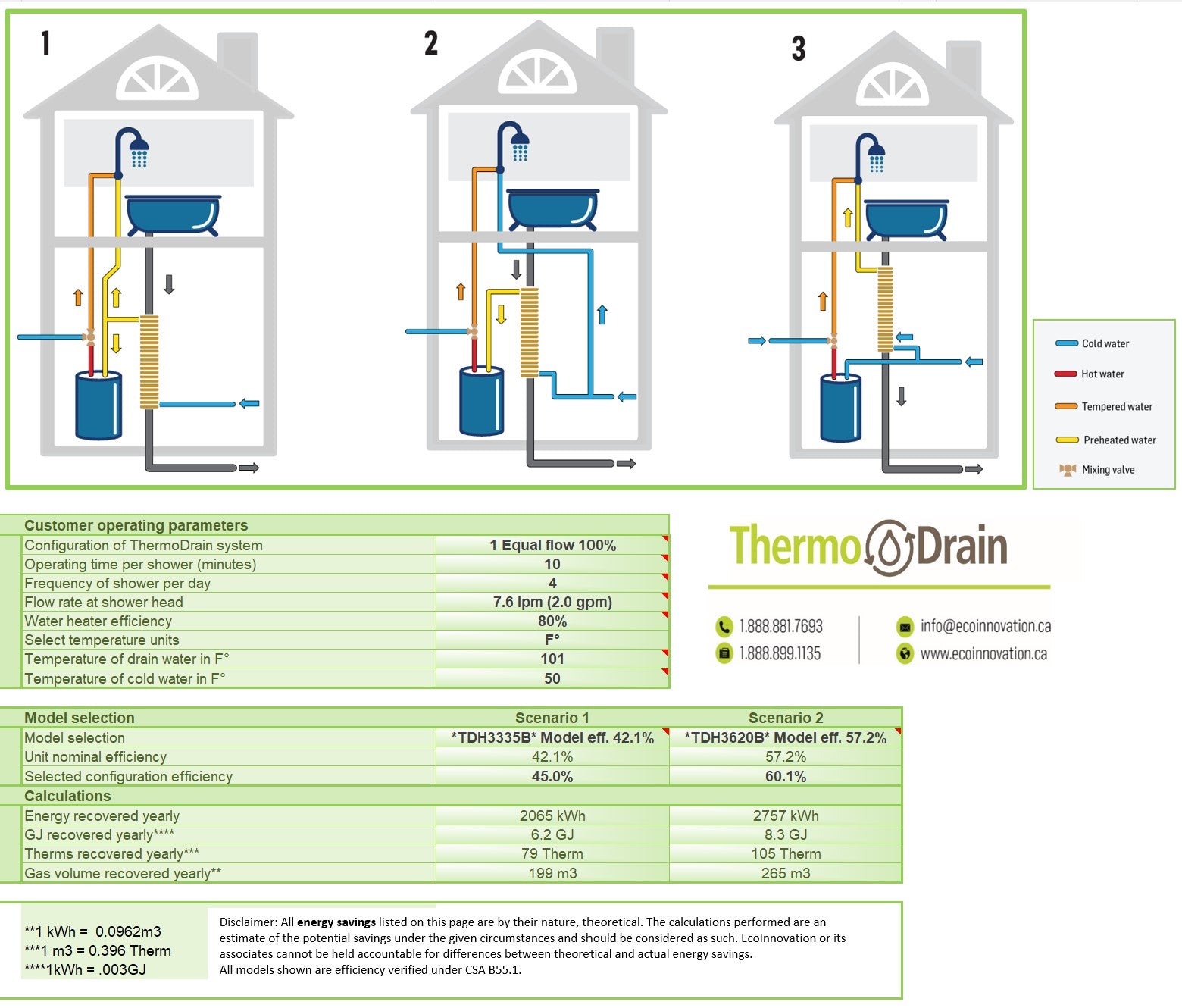
- Plumbing Configuration: Select Equal Flow. In this setup, preheated water from the ThermoDrain feeds both the cold inlet of the water heater and the cold port of the primary shower mixing valve. This delivers balanced pressure and the largest modeled HERS point deduction.
- Stack Serviced: Apply the recovery to the vertical stack receiving greywater from the primary shower(s).
Lower HERS Scores, Protected Profit Margins
For HERS Raters and Energy Advisors designing paths to Section 45L credits ($2,500 or $5,000 per home) or meeting local IECC stretch codes, the ThermoDrain TDX3240B is the ultimate precision tool. It delivers the exact point margin required to cross certification finish lines at a fraction of the cost of building envelope upgrades—keeping builder budgets intact and trade contractors on schedule.










No comment yet, add your voice below!