


BC Energy Step Code & HOT2000 Modeling: DWHR Engineering Analysis & CEA Compliance Package
A steady-state mass and energy balance evaluating the integration of CSA B55.1 tested Drain Water Heat Recovery (DWHR) units under the British Columbia Building Code (BCBC 2024, Part 9 Subsection 9.36.6 and Part 10), the Zero Carbon Step Code (ZCSC), and Natural Resources Canada (NRCan) HOT2000 v11.10b+ / v11.12+ simulation rules. This application note defines explicit boundary conditions, reconciled enthalpy balances, multi-variable sensitivity modeling across BC Climate Zones 4–7A, Mechanical Energy Use Intensity (MEUI) compliance paths, and a CSI MasterFormat guide specification for Certified Energy Advisors (CEAs), mechanical engineers, and architects.
Summary of Engineering Findings (BC Energy Step Code & HOT2000)
- Resolving the Step 4 & Step 5 "MEUI Bottleneck": As building enclosures tighten to meet Thermal Energy Demand Intensity (TEDI ≤ 15–25 kWh/(m²·a)), domestic water heating expands to 35% to 50%+ of the total allowable Mechanical Energy Use Intensity (MEUI) budget. Modeling an Equal Flow ThermoDrain unit in HOT2000 directly reduces modeled DHW energy consumption, delivering an indicative 2.5 to 5.5 kWh/(m²·a) MEUI reduction to clear Step 4 and Step 5 caps without cost-prohibitive structural wall changes.
-
Reconciled Thermal Load Reduction (38.6% to 50.5%): At baseline winter design conditions (7.2°C / 45.0°F cold mains, 40.6°C / 105.0°F shower at 7.57 L/min / 2.00 GPM, 37.8°C / 100.0°F drain inlet, 48.9°C / 120.0°F storage), an Equal Flow ThermoDrain
TDX3350(η = 42.10%) preheats cold supply water to 20.1°C (68.2°F). This reduces 48.9°C tank flow draw from 6.06 L/min to 5.38 L/min (1.60 to 1.42 GPM, an 11.3% volumetric reduction) while cutting net thermal power demanded from the water heater from 17.58 kW down to 10.79 kW (60,000 to 36,840 BTU/hr, a 38.6% net load reduction). - Zero Carbon Step Code (ZCSC) Operational Alignment: Under municipal zero-carbon bylaws (City of Vancouver, City of Victoria, Saanich, North Vancouver, Kelowna), reducing water-heating electrical consumption directly lowers operational Greenhouse Gas Intensity (GHGI in kg CO&sub2;e/(m²·a)), accelerating compliance with EL-2, EL-3, and EL-4 (Zero Carbon) tiers.
- Cold Climate Heat Pump Water Heater (HPWH) Integration: In Interior and Northern BC (Zones 5 to 7A), municipal winter mains enter at 4.0°C–8.0°C. Recovering 6.79 kW (23,160 BTU/hr with TDX3350) slows the stored tank enthalpy depletion rate by 41.5%, delaying upper-thermostat temperature shock and reducing the operational staging of 4,500W electric resistance backup elements.
- Regulatory & Testing Precision: CSA B55.1:20 (R2025) is the laboratory performance test method governing rated efficiency (%) and potable head loss (< 17.2 kPa / < 2.5 psi at 9.5 L/min / 2.5 GPM); CSA B55.2:20 governs physical double-wall vented air-gap safety. Modeled MEUI outcomes depend on project-specific HOT2000 simulations and climatic data.
1. BC Building Code Architecture: TEDI, MEUI & ZCSC Metrics
The British Columbia Building Code (BCBC 2024, Revision 5) regulates housing through Part 9 Subsection 9.36.6 (Energy Step Code) and Part 10 (Large / Complex Buildings). Compliance requires simultaneous verification of three independent energy metrics:
TEDI: Thermal Energy Demand Intensity
Measures annual heating energy required to maintain conditioned space per square metre (kWh/(m²·a)), isolating the building envelope (airtightness, fenestration, insulation). DWHR does not directly impact TEDI except through minor internal gain adjustments.
MEUI: Mechanical Energy Use Intensity
Measures annual energy used by mechanical systems: Space Heating + Space Cooling + Domestic Water Heating (DHW) + Ventilation (kWh/(m²·a)). DWHR directly reduces the DHW component of MEUI in HOT2000.
ZCSC: Zero Carbon Step Code (GHGI)
Enforces maximum Greenhouse Gas Intensity (kg CO&sub2;e/(m²·a)) across tiers EL-1 (Measurable) through EL-4 (Zero Carbon). Recovering shower effluent heat directly slashes annual electricity/fuel consumption to satisfy municipal carbon caps.
To evaluate mechanical performance without unverified claims, all thermodynamic calculations in this document are established under the explicit boundary conditions below:
Design Operating Parameters (Equal Flow Reference Case):
- Shower Flow Rate (Qs): 7.57 L/min (2.00 GPM) steady-state. Assumes single fixture operating; non-concurrent laundry or lavatory draws.
- Mixed Showerhead Delivery Temperature (Ts): 40.6°C (105.0°F).
- Drain Inlet Temperature (Td): 37.8°C (100.0°F), establishing a 2.8°C (5.0°F) sensible temperature drop across the shower receptor, pan conduction, and trap arm.
- Incoming Winter Cold Water Main (Tc,in): 7.2°C (45.0°F), representative of coastal South Coast winter municipal water supply (Metro Vancouver / Capital Regional District winter range: 6.0°C–9.0°C; Interior/Northern BC winter range: 3.0°C–6.0°C).
- Storage Tank Setpoint (Th): 48.9°C (120.0°F) delivered at the tank outlet port.
-
Certified Effectiveness (η): Evaluated at published CSA B55.1:20 laboratory test ratings: 42.10% for ThermoDrain
TDX3350and 55.04% for ThermoDrainTDX3615. Rated test values are applied directly without unverified field adjustments. - Thermodynamic Constants: Density of water ρ = 1.00 kg/L (8.34 lb/gal); specific heat capacity Cp = 4.184 kJ/(kg·°C) (1.00 BTU/(lb·°F)); volumetric constant = 500 BTU/(hr·GPM·°F).
2. Reconciled Steady-State Heat & Mass Balance Equations (SI & Imperial)
Under steady-state continuous flow, the mass and energy balances across the mixing valve, DWHR exchanger, and storage tank are governed by Equations 1 through 5:
(Eq. 2) 48.9°C Tank Draw Rate: Q_h = Q_s × (T_s − T_pre) / (T_h − T_pre)
(Eq. 3) Total Showerhead Demand: q_shower = ρ × C_p × Q_s × (T_s − T_c,in)
(Eq. 4) Heat Recovered by DWHR: q_dwhr = ρ × C_p × Q_s × (T_pre − T_c,in)
(Eq. 5) Net Thermal Tank Load: q_tank = ρ × C_p × Q_h × (T_h − T_pre) = q_shower − q_dwhr
| Thermodynamic Parameter | Baseline (No DWHR) Tc = 7.2°C (45.0°F) |
With TDX3350 η = 42.10% (CSA B55.1) |
With TDX3615 η = 55.04% (CSA B55.1) |
|---|---|---|---|
| Preheated Potable Temp (Tpre) | 7.2°C (45.0°F) | 20.1°C (68.2°F, +12.9°C lift) | 24.0°C (75.3°F, +16.8°C lift) |
| Tank Hot Water Flow (Qh) | 6.06 L/min (1.60 GPM) | 5.38 L/min (1.42 GPM, -11.3%) | 5.03 L/min (1.33 GPM, -16.9%) |
| Cold Mixing Bypass Flow (Qc) | 1.51 L/min (0.40 GPM) | 2.19 L/min (0.58 GPM) | 2.54 L/min (0.67 GPM) |
| Total Showerhead Demand (qshower) | 17.58 kW (60,000 BTU/hr) | 17.58 kW (60,000 BTU/hr) | 17.58 kW (60,000 BTU/hr) |
| Heat Recovered by DWHR (qdwhr) | 0.00 kW (0 BTU/hr) | 6.79 kW (23,160 BTU/hr) | 8.87 kW (30,270 BTU/hr) |
| Net Thermal Load on Tank (qtank) | 17.58 kW (60,000 BTU/hr) | 10.79 kW (36,840 BTU/hr, -38.6%) | 8.71 kW (29,730 BTU/hr, -50.5%) |
| Active Compressor Output (Nominal) | 1.23 kW (4,200 BTU/hr) | 1.23 kW (4,200 BTU/hr) | 1.23 kW (4,200 BTU/hr) |
| Net Stored Enthalpy Depletion Rate (qtank − qcomp) |
16.35 kW (55,800 BTU/hr) | 9.56 kW (32,640 BTU/hr, -41.5%) | 7.48 kW (25,530 BTU/hr, -54.2%) |
Distinguishing Volumetric Flow Rate from Thermal Enthalpy
A frequent modeling misconception in energy modeling is equating volumetric tank draw reduction with net thermal energy savings. Under the TDX3350 baseline, 48.9°C hot water drawn from the storage tank drops by 11.3% (from 6.06 to 5.38 L/min). However, because incoming replacement water entering the bottom dip tube is preheated to 20.1°C instead of 7.2°C, the temperature lift required of the water heater is reduced from 41.7°C to 28.8°C. The compound product of lower flow and reduced temperature lift yields the 38.6% reduction in instantaneous thermal power (kW / BTU/hr).
3. Multi-Variable Sensitivity Analysis: BC Climate Zones 4, 5, 6 & 7A
British Columbia spans diverse climatic conditions, from temperate maritime (Zone 4: Vancouver, Victoria) to cold semi-arid (Zone 5: Kelowna, Kamloops) and subarctic interior (Zone 6 & 7A: Prince George, Fort St. John). Table 2 evaluates system response across varying cold mains temperatures, drain temperatures, and fixture flow rates using the ThermoDrain TDX3350 (η = 42.10%):
| Simulation Case | Mains (Tc,in) | Drain (Td) | Flow (Qs) | Preheat (Tpre) | Tank Draw (Qh) | Baseline Qh | Net Load Reduction |
|---|---|---|---|---|---|---|---|
| Case 1: South Coast Winter (Vancouver/Victoria) | 7.2°C (45.0°F) | 37.8°C (100.0°F) | 7.57 L/min (2.00 GPM) | 20.1°C (68.2°F) | 5.38 L/min | 6.06 L/min | -38.6% (-6.79 kW) |
| Case 2: Northern BC Winter (Prince George Zone 7A) | 3.9°C (39.0°F) | 36.7°C (98.0°F) | 7.57 L/min (2.00 GPM) | 17.7°C (63.8°F) | 5.56 L/min | 6.17 L/min | -38.3% (-7.28 kW) |
| Case 3: Okanagan Shoulder Season (Kelowna Zone 5) | 11.1°C (52.0°F) | 37.8°C (100.0°F) | 7.57 L/min (2.00 GPM) | 22.3°C (72.2°F) | 5.19 L/min | 5.91 L/min | -38.1% (-5.92 kW) |
| Case 4: Low-Flow Fixture (WaterSense 5.7 L/min) | 7.2°C (45.0°F) | 36.7°C (98.0°F) | 5.68 L/min (1.50 GPM) | 19.6°C (67.3°F) | 4.05 L/min | 4.54 L/min | -37.3% (-4.90 kW) |
| Case 5: Conservative Trap Arm Heat Loss | 7.2°C (45.0°F) | 35.0°C (95.0°F) | 7.57 L/min (2.00 GPM) | 18.9°C (66.1°F) | 5.45 L/min | 6.06 L/min | -35.1% (-6.17 kW) |
4. NRCan HOT2000 Modeling Protocol for Certified Energy Advisors
To ensure modeled compliance clears local building official plan review (e.g., City of Vancouver, City of Surrey, Saanich, Kelowna), Certified Energy Advisors (CEAs) must enter DWHR components into NRCan HOT2000 (v11.10b+ or v11.12+) in strict accordance with the EnerGuide Rating System (ERS) Technical Procedures:
HOT2000 DHW Component Entry Sequence:
- Component Selection: Under the Domestic Water Heating tab, open the primary water heating system and check "Drain Water Heat Recovery (DWHR)".
- Efficiency Rating: Select pre-populated manufacturer library or choose User-Defined and enter the certified CSA B55.1 rated efficiency (42.10% for TDX3350; 55.04% for TDX3615).
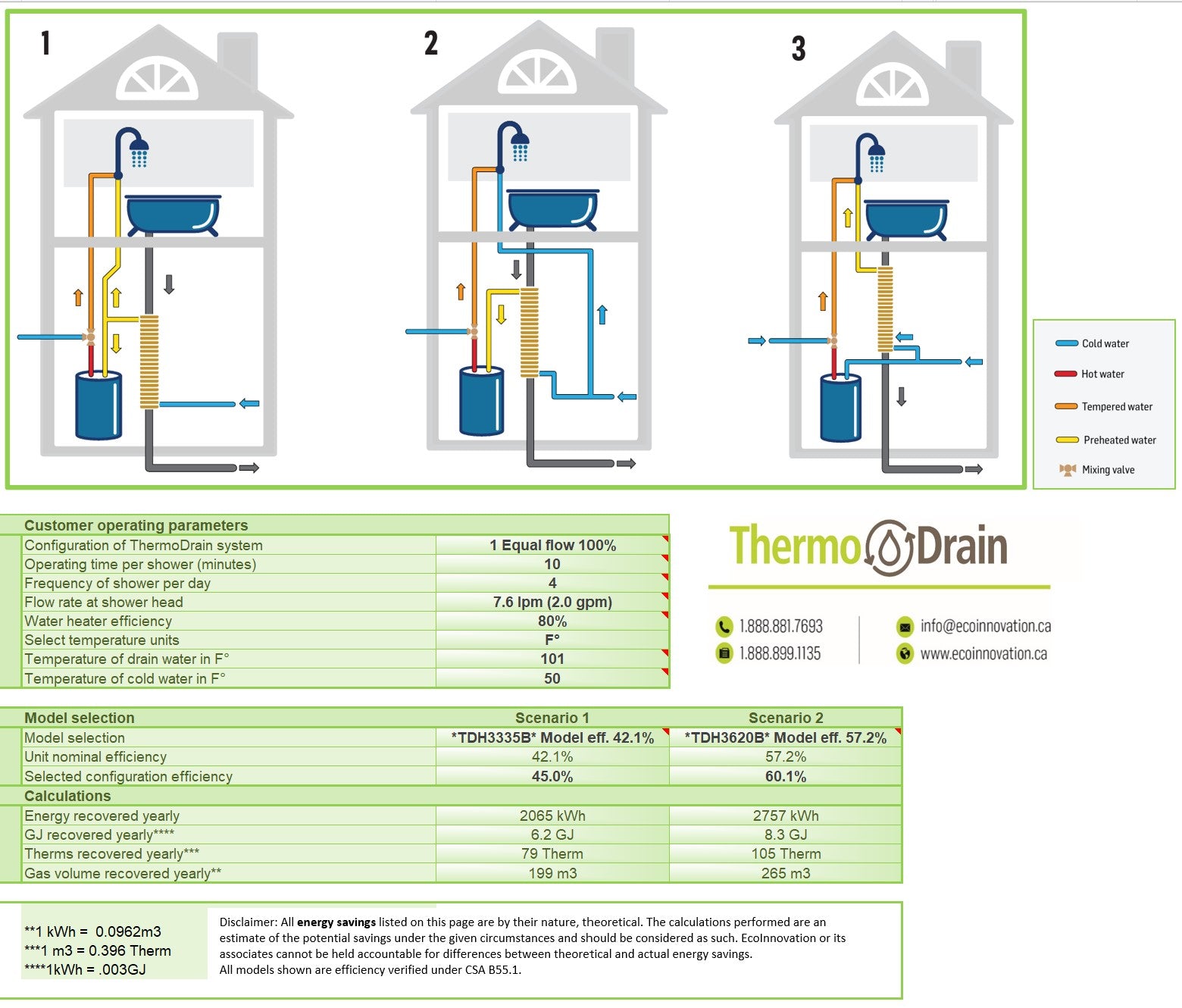
- Plumbing Configuration: Select "Equal Flow" (preheated water supplies both the cold inlet of the DHW tank and the shower cold valves) or "Unequal Flow" (preheated water routes exclusively to the DHW storage tank).
- Showers Connected: Specify the exact fraction of showers plumbed into the DWHR stack. For single-family dwellings where all upper-floor showers drop down a single vertical stack, enter 100% (or All showers connected). For multi-stack layouts, enter the proportional fraction.
- Verification Submittal: Attach the manufacturer's CSA B55.1 / CSA B55.2 listing cut sheet to the BC Energy Step Code Compliance Report submitted for building permit application.
MEUI Point Delta: In standard 220–260 m² detached reference homes across Climate Zones 4 and 5, integrating an Equal Flow ThermoDrain unit into HOT2000 models typically yields an absolute 2.5 to 5.5 kWh/(m²·a) MEUI reduction. Because Step 4 and Step 5 MEUI caps are fixed targets (e.g., MEUI ≤ 25–45 kWh/(m²·a)), this 3.5 kWh/(m²·a) delta frequently represents 15%–20% of the builder's entire allowable mechanical energy consumption.
5. Value Engineering: DWHR vs. Deep Envelope Upgrades for Step 4 & 5
Once a design clears its Step 4 or Step 5 TEDI threshold, further upgrading the opaque envelope produces diminishing returns on MEUI. Comparing mechanical DWHR integration against advanced envelope measures illustrates the capital cost and framing efficiency:
| Compliance Strategy | Estimated Cost Delta | Modeled MEUI Impact | Framing & Field Constructability |
|---|---|---|---|
| Triple-Pane Passive House Glazing (U ≤ 0.85) | +$6,000 – $12,000 CAD | -1.5 to -2.5 kWh/(m²·a) | Substantial frame weight; structural bucking and modified rough openings. |
| Exterior Continuous Mineral Wool (R-12 ci) | +$8,500 – $14,000 CAD | -2.0 to -3.5 kWh/(m²·a) | Requires engineered strapping fasteners, jamb extensions, and rainscreen detailing. |
| Sub-Slab R-16 XPS Rigid Foam Package | +$4,000 – $7,000 CAD | -1.0 to -2.0 kWh/(m²·a) | Thermal break coordination at perimeter grade beams and under-slab plumbing penetrations. |
| ThermoDrain® TDX3350 / TDX3615 | ~$440 – $720 CAD (Equip.) | -2.5 to -5.5 kWh/(m²·a) | Zero framing changes. Installs inside standard 2×4 / 2×6 wall chase. 45-min rough-in. |
6. ThermoDrain® Model Specifications (CSA B55.1 & CSA B55.2)
| Model Number | Stack & Length | CSA B55.1 Eff. | Primary BC Building Code & Step Code Application |
|---|---|---|---|
| TDX3350 | 3.0" Stack × 35.0" (889 mm) | 42.10% | Standard Builder Baseline: Single-Family & Townhome Step 3/4 MEUI Compliance |
| TD442 | 4.0" Stack × 42.0" (1067 mm) | 46.20% | Part 3 / Part 9 Multi-Unit Residential (MURB) 4" Drainage Risers & Central Plants |
| TDX3615 | 3.0" Stack × 61.5" (1562 mm) | 55.04% | Step 5 / Net-Zero Ready, Passive House, and Unequal Flow Configurations |
| TDX3240B | 3.0" Stack × 24.0" (610 mm) | 33.59% | Restricted Vertical Clearance: Garden Suites, ADUs, and Crawlspaces < 850 mm Height |
7. Constructability & BC Wholesale Trade Distribution
Mechanical contractors across the Lower Mainland, Vancouver Island, the Okanagan, and Northern BC can source ThermoDrain units through authorized Canadian plumbing wholesale networks:
- Direct Solvent-Weld Hubs: Direct factory ABS or PVC hubs cement directly into standard DWV drain lines using standard solvent cement—eliminating mechanical rubber shielded couplings and ensuring rigid joint compliance under the BC Plumbing Code (BCPC Section 2.2).
- Factory 3/4" PEX Connections: Potable connections comply with CSA B137.5 (ASTM F1807 metal crimp and ASTM F1960 cold expansion), eliminating open flame and soldering near wood framing assemblies.
- Vertical Plumb Tolerance: The exchanger must be installed within 5 degrees of vertical plumb on the primary shower stack to maintain uniform annular falling-film fluid dynamics.
8. CSI MasterFormat 3-Part Guide Specification (Section 22 31 16)
Mechanical engineers and architects specifying DWHR for BC Energy Step Code projects can copy and paste this specification block directly into MasterFormat Section 22 31 16 (Domestic Water Heat Exchangers):
PART 1 — GENERAL
1.1 SECTION INCLUDES: Vented double-wall falling-film drain water heat recovery units for BC Building Code Subsection 9.36.6 (Energy Step Code) MEUI compliance.
1.2 QUALITY ASSURANCE: Unit shall be tested and listed in accordance with CSA B55.1:20 (R2025) and certified to CSA B55.2:20. Potable water-side head loss shall not exceed 17.2 kPa (2.5 psi) at 9.5 L/min (2.5 GPM). Certified efficiency shall be rated in accordance with CSA B55.1.
PART 2 — PRODUCTS
2.1 ACCEPTABLE MANUFACTURER: EcoInnovation Technologies Inc. (ThermoDrain Series TDX/TD).
2.2 PRODUCT SPECIFICATION: Model [TDX3350 (3" stack, 42.10% eff.) / TDX3615 (3" stack, 55.04% eff.) / TD442 (4" stack, 46.20% eff.)]. Exchanger shall feature seamless Type DWV copper drain core with exterior mechanically bonded double-wall copper potable wrap and vented atmospheric path between fluid streams.
2.3 CONNECTIONS: Drain connections shall be factory ABS or PVC direct solvent-weld hubs. Potable water connections shall be factory 3/4" PEX (CSA B137.5 / ASTM F1807 / ASTM F1960).
PART 3 — EXECUTION
3.1 INSTALLATION: Install unit vertically on primary shower drain stack, not exceeding 5 degrees from plumb. Maintain manufacturer specification label visible for pre-drywall Energy Advisor inspection.
3.2 PIPING CONFIGURATION: Plumb in Equal Flow arrangement: route potable preheated outlet to feed both the cold inlet of the primary domestic water heater and the cold inlet port of the primary shower thermostatic mixing valve. Provide full-port isolation valves and drain port on potable inlet/outlet.
3.3 INSULATION: Insulate all exposed preheated potable piping with minimum 12.7 mm (1/2") closed-cell elastomeric pipe insulation complying with BC Building Code Article 9.36.4.2.
Modeling a Part 9 or Part 3 Project under the BC Step Code?
EcoInnovation supports Canadian Energy Advisors, mechanical engineers, and builders with CSA B55.1 submittal certificates, HOT2000 modeling data, and wholesale volume pricing.







No comment yet, add your voice below!