


The Lowest Cost-Per-Point in BC: Why ThermoDrain® DWHR Belongs in Every Part 9 Home and Part 3 MURB
As the BC Energy Step Code tightens toward Net-Zero Energy Ready and the Zero Carbon Step Code limits operational emissions, domestic hot water has become the single largest mechanical load. Here is how specifying certified Drain Water Heat Recovery unlocks Step 4/5 compliance and CMHC MLI Select preferential financing at the lowest cost-per-point in the industry.
Executive Summary for BC Builders, Developers & Energy Advisors
- The Part 9 & MURB Dilemma: Envelope upgrades (triple glazing, R-30+ walls) face steep diminishing economic returns. Once airtightness reaches ≤ 1.5 ACH50, domestic water heating accounts for 35% to 50%+ of total building energy consumption.
- CMHC MLI Select Financing: Earning 20 to 50 Energy Efficiency points unlocks up to 50-year amortization, 95% Loan-to-Cost (LTC), and up to 30% premium discounts. ThermoDrain provides the lowest capital expenditure to clear the required 20% to 40% performance improvement thresholds over NECB/NBC Tier 1 baselines.
- Zero Carbon Step Code (EL-3 / EL-4): Preheating incoming potable cold water by 20°C to 25°C cuts central heat pump water heater (HPWH) sizing, mechanical room square footage, and electrical service entrance requirements.
- Certified Reliability: Certified strictly to CSA B55.1 (Performance) and CSA B55.2 (Safety), featuring direct solvent-weld glue hubs, factory 3/4" PEX fittings, a 40+ year lifecycle, and zero moving parts.
1. The Domestic Hot Water Blindspot in BC’s Step Code
Since Step 3 became the provincial minimum for Part 9 residential construction across British Columbia—and with forward-thinking municipalities like Vancouver, Whistler, North Vancouver, and Victoria mandating Step 4 or Step 5—the physics of residential energy modeling have radically inverted.
In an uninsulated 1990s home, space heating accounted for upwards of 70% of energy usage. Today, in an airtight home built to high Thermal Energy Demand Intensity (TEDI) standards, space conditioning demands are minimal. In both high-performance single-family homes and mid-rise Multi-Unit Residential Buildings (MURBs), Domestic Hot Water (DHW) is now the primary energy consumer and peak load driver.
Pouring thousands of dollars into thicker exterior continuous insulation, specialized structural window bucks, or exotic glazing packages to squeeze out the next fraction of a step yields diminishing returns. In contrast, Drain Water Heat Recovery (DWHR) captures the high-grade heat currently flushed down the drain, instantly recovering 33% to 55%+ of shower thermal energy before it leaves the building footprint.
2. CMHC MLI Select: Supercharging MURB Pro Formas via Energy Efficiency
For developers building purpose-built rental MURBs, multiplexes, or student housing in British Columbia, the Canada Mortgage and Housing Corporation (CMHC) MLI Select program is the premier financing mechanism. By achieving specific point thresholds, developers access substantial financing advantages:
| MLI Select Score | Max Loan-to-Cost (LTC) | Max Amortization | Insurance Premium Discount |
|---|---|---|---|
| 50 Points (Base Tier) | Up to 85% - 95% | Up to 40 Years | 10% Discount |
| 70 Points (Enhanced Tier) | Up to 95% | Up to 45 Years | 20% Discount |
| 100 Points (Maximum Tier) | Up to 95% | Up to 50 Years | 30% Discount |
How the MLI Select Energy Efficiency Bucket Works
Under CMHC guidelines, projects can earn up to 50 points through energy performance and greenhouse gas (GHG) reductions compared to the reference baseline (National Energy Code for Buildings [NECB 2020] for Part 3, or NBC 2020 Part 9):
- Level 1 (20 Points): Minimum 20% to 25% energy reduction over baseline.
- Level 2 (35 Points): Minimum 25% to 40% energy reduction over baseline.
- Level 3 (50 Points): Minimum 40%+ energy reduction over baseline.
The Winning Multiplex / MURB Strategy: Because energy efficiency caps at 50 points, developers combine Energy Level 1 (20 pts) or Level 2 (35 pts) with Affordability commitments (50 to 70 pts) to comfortably secure the 70-point or 100-point tier.
By dropping DHW loads by 30% to 40% per suite, ThermoDrain allows mechanical consultants to demonstrate the required 20% to 40% whole-building energy efficiency leap without redesigning envelope assemblies, eliminating balcony thermal bridges, or downsizing glazing.
3. Cost-Per-Point Economics: Envelope vs. ThermoDrain®
Whether optimizing a single-family Step 4 model in HOT2000 or running a Part 3 NECB simulation in EnergyPlus/OpenStudio, mechanical capital expenditures vary drastically per percentage point of efficiency gained:
| Efficiency Upgrade | Added Cost / Door | Structural & Architectural Impact | Cost-Per-Point Efficiency |
|---|---|---|---|
| Triple-Pane Window Package | $5,000 – $10,000+ | Heavy framing, structural reinforcement | $2,500 – $4,500 / pt |
| Exterior Continuous Foam (R-10+) | $6,500 – $12,000+ | Extended jambs, rainscreen bracket redesign | $3,200 – $5,000 / pt |
| Oversized Central Heat Pump Water Heating | $3,500 – $6,000 | Larger electrical service, heavy mechanical footprints | $1,800 – $2,800 / pt |
| ThermoDrain® TDX Series (DWHR) | $450 – $850 installed | Zero architectural changes. Fits standard plumbing chase. | $150 – $350 / pt |
4. Certified BC Energy Modeling Inputs (CSA B55.1 / CSA B55.2)
To ensure seamless compliance reporting with Energy Advisors, municipal plan examiners, and CMHC underwriting assessors, provide these certified CSA parameters directly into your HOT2000, Ekotrope, or EnergyPlus model:
| Model Line | Stack Size & Height | CSA B55.1 Efficiency | Recommended BC Application |
|---|---|---|---|
| ThermoDrain TDX3240B | 3.0" Stack | 24.0" (61.0 cm) | 33.59% (Equal Flow) | Part 9 single-family baseline & tight ceiling heights |
| ThermoDrain TDX3350 | 3.0" Stack | 35.0" (88.9 cm) | 42.10% (Equal Flow) | Part 9 Step 4/5, Multiplexes & Townhomes |
| ThermoDrain TD442 | 4.0" Stack | 42.0" (106.7 cm) | 46.20% (Equal Flow) | Part 3 Multi-Unit Residential (MURBs) multi-storey stacks |
| ThermoDrain TDX3615 | 3.0" Stack | 61.5" (156.2 cm) | 55.04% (Equal Flow) | Net-Zero Energy Ready & Passive House single-family |
Plumbing Trade & Engineering Installation Advantages:
- Direct Solvent-Weld Glue Hubs: Standard ABS or PVC drain hubs cement directly to the vertical drain stack without mechanical rubber Fernco couplings, eliminating leak risks and ensuring full compliance with the BC Plumbing Code.
- Factory 3/4" PEX Fittings: Engineered with factory-crimped PEX connections, requiring zero open flame, torches, or hot-work permits inside wood-frame multi-residential buildings.
- True Double-Wall Vented Core: Fully complies with CSA B55.2 safety standards with an atmospheric air gap between greywater and potable water pathways, preventing cross-contamination under all operating pressures.
- Minimal Pressure Drop: Exhibits < 2.5 psi pressure drop across potable lines at standard 9.5 LPM (2.5 GPM) shower flows, ensuring balanced fixture pressures in multi-bathroom suites.
5. Ready-to-Paste Mechanical Specification Clause
Mechanical engineers and architects specifying Part 9 or Part 3 projects in BC can copy and paste this standard general note directly onto plumbing drawings:
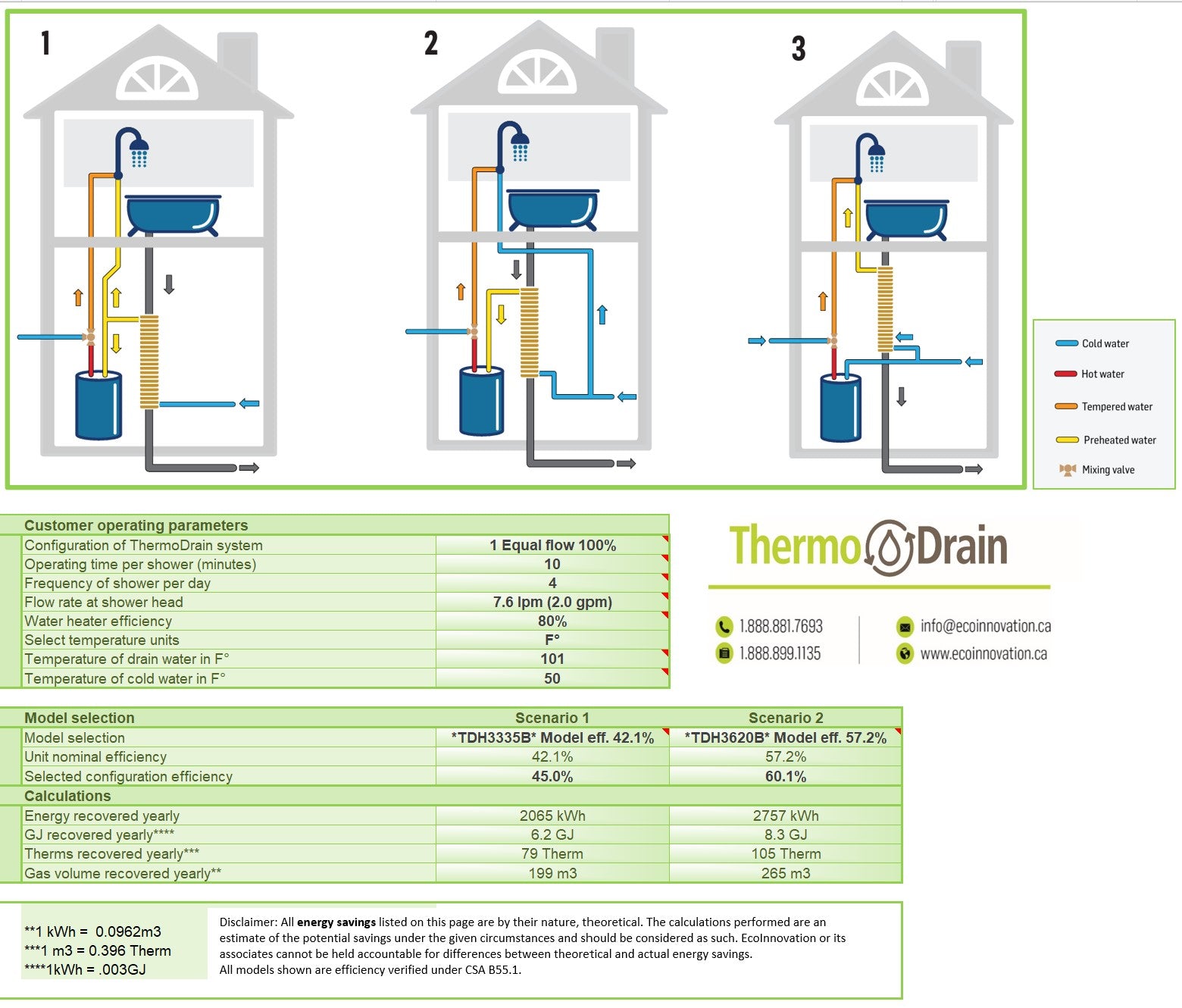
PLUMBING CONTRACTOR SHALL INSTALL UNIT ON VERTICAL SECTION OF PRIMARY SHOWER WASTE STACK IN EQUAL FLOW CONFIGURATION (PREHEATED POTABLE WATER CONNECTED TO FEED BOTH WATER HEATER COLD INLET AND PRIMARY SHOWER MIXING VALVE COLD PORT) IN ACCORDANCE WITH MANUFACTURER SPECIFICATIONS."
Modeling a BC Project or Preparing an MLI Select Submission?
EcoInnovation supports BC Energy Advisors, mechanical engineers, and developers with custom modeling files, CSA B55.1 compliance letters, and direct wholesale volume pricing for multi-unit projects.






No comment yet, add your voice below!